My kids and I produced a video on the different types of motion that are studied by our 1st graders.
Teacher | Virginia Trekker | Instructional Technologist
My kids and I produced a video on the different types of motion that are studied by our 1st graders.
 Being that 2012 is a
mudslinging election year, I am officially joining the campaign[1. This campaign is completely fictional and only exists in my head.] for Angry Birds to be on every device possible. I know it is a game, but since when are games banned from classrooms, especially strategy games?[2. When I had a classroom of my own, I had a class set of chess boards.] Out of all of the apps and potential I have my devices, Angry Birds draws me in every time. I am OK with this addiction. It is not just a game in which you hurl colorful birds towards cowardly and sometimes awkwardly dressed pigs. In order to receive full credit for destroying the pigs dream of world domination, you have to do some serious thinking. The popularity of Angry Birds will help teachers introduce different types of projects that will be used throughout the school year. Here are some ideas for using Angry Birds in your classroom.
Classroom teachers, especially at the elementary level, have daily morning work assignments. These assignments usually include a daily math or language arts problem. Why not include a screen shot of a level of Angry Birds? Look it as a puzzle instead of a game. The students could write the directions, or sketch, what they think would be the best order to complete the level with the highest score possible. Because it usually takes more than one bird to complete a level, the students have to think a couple of steps ahead. Teaching the students to think ahead is not just a skill that is needed to be successful at this game, but it is important skill to have in many academic areas and life. If you have an interactive whiteboard, this would be great way for kids to display their ideas for a successful high score. There are more than enough levels to do one a day.
I see a lot of potential for using Angry Birds in Language Arts. I would love for there to be a Three Little Pigs: Pigs vs Birds. Sure the Big Bad Wolf couldn’t blow the houses down, but the individual characteristics of each bird could certainly get the job done.
Since each of the birds has it’s own personality, biographies are another potential way to incorporate Angry Birds into writing. Unleashing students to document the life stories of the birds would be an entertaining read.
The 4 Icon Challenge originated from the DS106 class offered at the University of Mary  Washington. The 4 Icon Challenges makes creators think about how they can summarize a story, book, movie, or in this case a game using just four icons. This is a tough task for many students, but it can be practiced using stories that they are already familiar with like The Three Little Pigs or Angry Birds.
 Art and Language Arts can go hand-in-hand with Minimalist Movie Posters, also a potential DS106 assignment. Minimalist Movie Posters make students streamline a summary from four icons to one overall theme. This will challenge students to truly think critically about the what they read or watched in order for one clean poster to be created. Because the posters are meant to be minimalist, great art skills aren’t required. Again this idea can be used for topics (including historical events), stories, novels, and movies that are studied in your classroom.
There are many different ways to use Angry Birds in science. There are topics, such as physics, that I have no business talking about that can integrate the use of Angry Birds. The scientific method and the skills of data collection, data analysis, and experimentation can be practiced with the use of Angry Birds. There are videos and links below that will take you to examples of the use of Angry Birds in science.
http://www.ictsteps.com/2011/06/angry-birds-in-the-classroom/
httpv://www.youtube.com/watch?v=KYh80PmMg_s
Having just worked with 5th graders on mean, median, mode, and range, Angry Birds would be a great way to study these topics. However, since the scores generated on certain levels can be quite high, a calculator or spreadsheet that uses formulas, may be a handy tool to have available. Students could find the average number of points scored by each bird. The mean, median, mode, and range of each class member’s attempt is another potential activity. Older students could determine the speed that the birds reach during their flights.
While I know that the chances of seeing Angry Birds in every classroom across the country is low, the potential is there for a couple of educators to use it effectively in their classroom. Just the mention of Angry Birds in a Kindergarten classroom generated cheers and excitement, why not sneak some learning in….
Additional Angry Birds ideas:
Two of my teammates have created tutorials that will help you get pictures and files off of your classroom iPads and onto your classroom computers by using the Drop Box app. It also works the other way around. You can use it to drop pictures from your computer onto the iPads in your classroom as well. Stephanie Wright has created a tutorial that will show you how to get started with DropBox. In her video it says that you need a GMail account. You can also use your HCPS email address. Karen Hues has created a handout that will show you how to share files that you have with other Drop Box users. Her handout uses HCPS email addresses to make share the files a little easier. If you have questions let me know.
Stephanie’s Video:
Karen’s Handout:
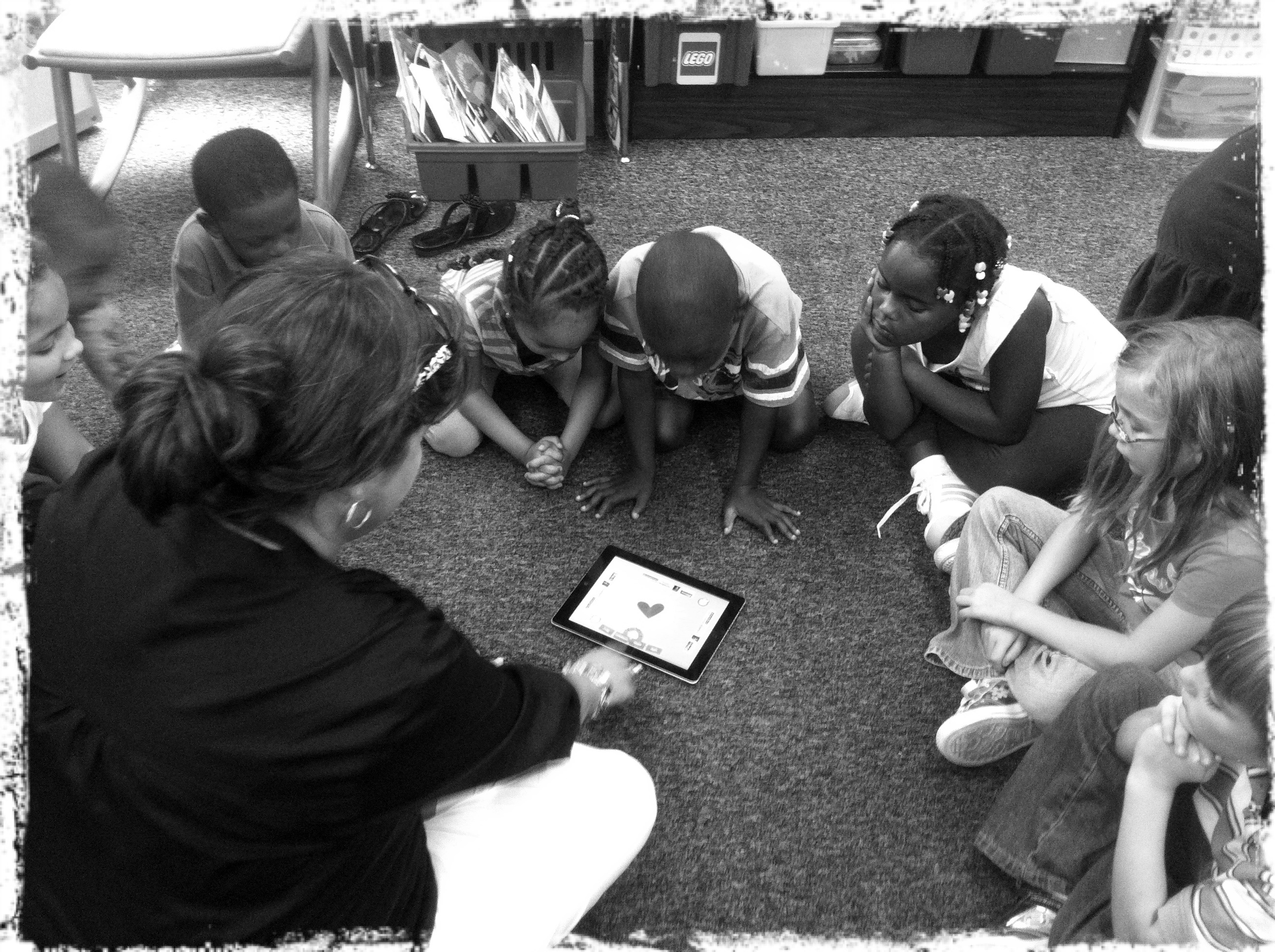
The iPads are officially in Kindergarten and 1st grade classrooms across the county. With this initiative this gives each Kindergarten and 1st grade classroom four (4) iPads and two (2) MacBooks. [1. The MacBooks that have been removed from the classrooms will be put on carts. The carts will be distributed county wide so that each school will have approximately have the same laptop-to-student ratio.] Each iPad came with a base image that was assembled by the elementary ITRTs and the elementary content specialists. With the unveiling of the new iPad operating system in October of 2011, we are hoping to put the control of the content that is found on the iPad into the hands of the classroom teachers that have them.
A website has been developed that explains the Apps that can be found on the iPads currently.

Amy Spiker, a 1st grade teacher at Longdale, introducing her students to the "App of the Day".
The ElemApps site also gives a description of each App and the directions on how to use it. As we will discover, the kids don’t need a lot of instruction. The touch feature is very intuitive for the students that are entering our schools.
The cases for the iPads will be arriving shortly and they will be distributed as soon as they are received. In the meantime, HCPS would like to have the iPads out in the classrooms and more importantly, in the hands of our students.
If you are teaching in a 3rd, 4th, or 5th grade classroom, don’t fret. There will be opportunities to use the iPads with your students as well. As we have already heard from HCPS administrators, the future of computers in our classrooms may be with “tablets” instead.
The Reflective Friends (RF) process has made it to Henrico County’s elementary schools! Before you say anything or before your eyes roll back into your head, Reflective Friends is what we have been wanting for a long time. I am very excited about RF being in the elementary schools this year. The process gives teachers an opportunity to receive positive feedback from observers that are not from their buildings. The observers are looking for the characteristics of a 21st Century Lesson. The students and teachers will be scored on the TIP-Chart that we have become familiar with. This is the same chart that is used to score Henrico 21 projects.
Here is the process broken down:
I am hoping to repeat this process in the spring in order to show authentic student and teacher growth during the 2011-2012 school year.
Here are the teachers that will be participating this year:


© 2026 Frank Fitzpatrick's Blog
Theme by Anders Noren — Up ↑