Teacher | Virginia Trekker | Instructional Technologist

Category: 4th Grade (Page 1 of 6)

Angry Birds in 2012

Being that 2012 is a mudslinging election year, I am officially joining the campaign[1. This campaign is completely fictional and only exists in my head.] for Angry Birds to be on every device possible.  I know it is a game, but since when are games banned from classrooms, especially strategy games?[2. When I had a classroom of my own, I had a class set of chess boards.]  Out of all of the apps and potential I have my devices, Angry Birds draws me in every time.  I am OK with this addiction. It is not just a game in which you hurl colorful birds towards cowardly and sometimes awkwardly dressed pigs.  In order to receive full credit for destroying the pigs dream of world domination, you have to do some serious thinking.  The popularity of Angry Birds will help teachers introduce different types of projects that will be used throughout the school year.  Here are some ideas for using Angry Birds in your classroom.

A level a day:

Classroom teachers, especially at the elementary level, have daily morning work assignments.  These assignments usually include a daily math or language arts problem. Why not include a screen shot of a level of Angry Birds?  Look it as a puzzle instead of a game.  The students could write the directions, or sketch, what they think would be the best order to complete the level with the highest score possible.  Because it usually takes more than one bird to complete a level, the students have to think a couple of steps ahead.  Teaching the students to think ahead is not just a skill that is needed to be successful at this game, but it is important skill to have in many academic areas and life.  If you have an interactive whiteboard, this would be great way for kids to display their ideas for a successful high score. There are more than enough levels to do one a day.

Language Arts:

I see a lot of potential for using Angry Birds in Language Arts.  I would love for there to be a Three Little Pigs: Pigs vs Birds.  Sure the Big Bad Wolf couldn’t blow the houses down, but the individual characteristics of each bird could certainly get the job done.

Since each of the birds has it’s own personality, biographies are another potential way to incorporate Angry Birds into writing.  Unleashing students to document the life stories of the birds would be an entertaining read.

The 4 Icon Challenge originated from the DS106 class offered at the University of Mary Washington.  The 4 Icon Challenges makes creators think about how they can summarize a story, book, movie, or in this case a game using just four icons.  This is a tough task for many students, but it can be practiced using stories that they are already familiar with like The Three Little Pigs or Angry Birds.

Art and Language Arts can go hand-in-hand with Minimalist Movie Posters, also a potential DS106 assignment. Minimalist Movie Posters make students streamline a summary from four icons to one overall theme.  This will challenge students to truly think critically about the what they read or watched in order for one clean poster to be created.  Because the posters are meant to be minimalist, great art skills aren’t required.  Again this idea can be used for topics (including historical events), stories, novels, and movies that are studied in your classroom.


Science:

There are many different ways to use Angry Birds in science.  There are topics, such as physics, that I have no business talking about that can integrate the use of Angry Birds.  The scientific method and the skills of data collection, data analysis, and experimentation can be practiced with the use of Angry Birds.  There are videos and links below that will take you to examples of the use of Angry Birds in science.

http://www.ictsteps.com/2011/06/angry-birds-in-the-classroom/

httpv://www.youtube.com/watch?v=KYh80PmMg_s

Angry Birds and Physics

Math

Having just worked with 5th graders on mean, median, mode, and range, Angry Birds would be a great way to study these topics.  However, since the scores generated on certain levels can be quite high, a calculator or spreadsheet that uses formulas, may be a handy tool to have available.  Students could find the average number of points scored by each bird.  The mean, median, mode, and range of each class member’s attempt is another potential activity.  Older students could determine the speed that the birds reach during their flights.

While I know that the chances of seeing Angry Birds in every classroom across the country is low, the potential is there for a couple of educators to use it effectively in their classroom.  Just the mention of Angry Birds in a Kindergarten classroom generated cheers and excitement, why not sneak some learning in….

Additional Angry Birds ideas:

http://ilearntechnology.com/?p=3970

Jamestown

This lesson was done in Cheryl Ives’s 4th grade class at Glen Allen Elementary.  The lesson has been submitted to Henrico 21 for the 2011-2012 school year.  In my opinion, this project is a great example on how to integrate multiple subjects and technology into a lesson.

Summary from Cheryl Ives’s Henrico 21 Lesson Plan:

After completing our studies of Jamestown (VS3a-g), the students were challenged with creating video segments that would cover the topics that were studied in our unit.  The segments covered topics that included John Smith, Christopher Newport’s fleet, and Tobacco.  The students created scripts, that were written in first-person, based on the study materials provided to them and facts that they have discovered while doing their own research.  The students had to find and create props and costumes that will help the audience recognize the topic they were speaking about.  The filming and editing of the final video product was organized and completed by the students in the classroom.  This project allowed the kids be creative and show their personalities in their work while expanding their knowledge of Jamestown.

Click here to download the full lesson plan and the scoring rubric.

Final Video Product:


Street Art = Hallway Art

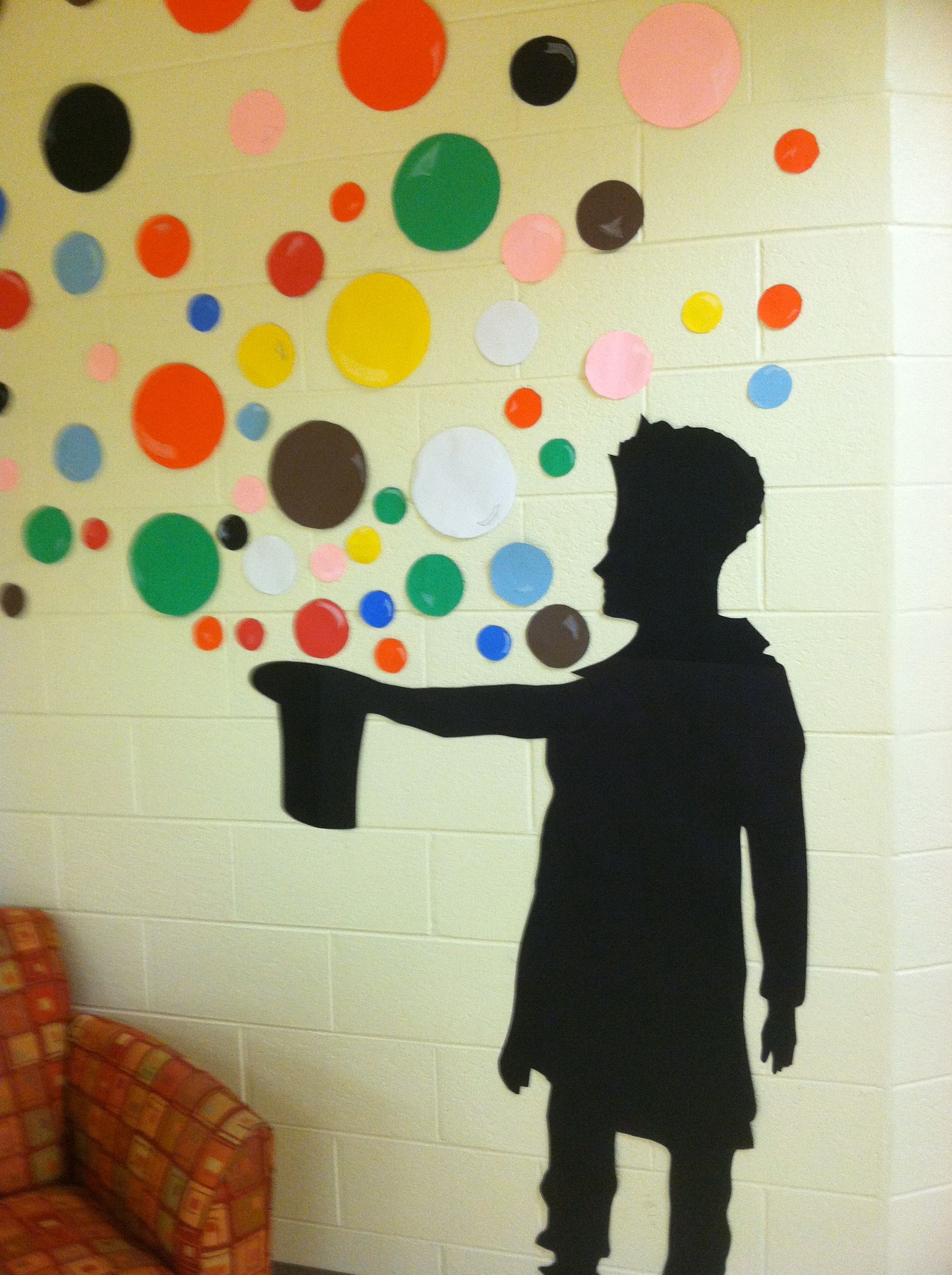
The art teacher at Harvie Elementary, Jordan Flower, has transformed the hallways into a street art exhibit.  The students in multiple grade levels have been learning about Street Art.  Street Art is usually viewed as destructive and “underground”.  However, if you look closely at the work that street artists create, and not so much where it is created, it’s clear that it is art. At last years Oscars, a street artist named Banksy was receiving a lot of attention because of his role in the nominated film Exit Through the Gift Shop.  The film took you on secretive missions to create works on nontraditional canvases around the world.[1. I have watched it 3 times from start to finish.] The students at Harvie are all familiar with street art and graffiti in their communities.  Jordan led them through discussions about art vs. vandalism and the effects, both positive and negative, that can come from street art.

The students at Harvie learned about a couple of different artists and styles, this was a unit studied in Kindergarten through 5th grade.  The 4th graders learned about the art of Kenny Random.  The 4th graders planned and executed a collaborative art piece, based on the work of Kenny Random, that can be found covering the walls of the school. Other pieces of art include arrows based on the work of Above, and a display of graffiti style “tags” of the student’s names.  Below are some images of the pieces around the school as well as Jordan’s lesson plan for the Henrico21 Kenny Random project with 4th grade.

Download the Henrico 21 Lesson Plan

[nggallery id=8]


4 Icon Challenge

The 4 Icon Challenge is an assignment that was submitted to the Digital Story Telling course (ds106) offered through the University of Mary Washington.  DS106 is a unique class because you don’t have to be a UMW student to participate.  Anyone can join and create art for the class. [1. Interested in joining, check out http://ds106.us/about/]  This would be a great way for a student to sum up a novel, film, or historical event.  The idea behind the 4 Icon Challenge is to create an images that represent the main ideas or events for the topic you have covered.  This type of challenge would work well in the “Creativity and Innovation” and “Critical Thinking and Problem Solving” sections of the TIP-Chart.  The example below is my 4 Icon Challenge that represents the book/film The Outsiders by S. E. Hinton.  I read the story in Middle School and observed a teacher using the book with her students during the Reflective Friends process.  I was glad to see that it was still being used. I used the drawing tools in Keynote to create my “icons”, but any drawing program, even crayons and markers, that you have available would work well.

Facebook and Twitter from the Past?

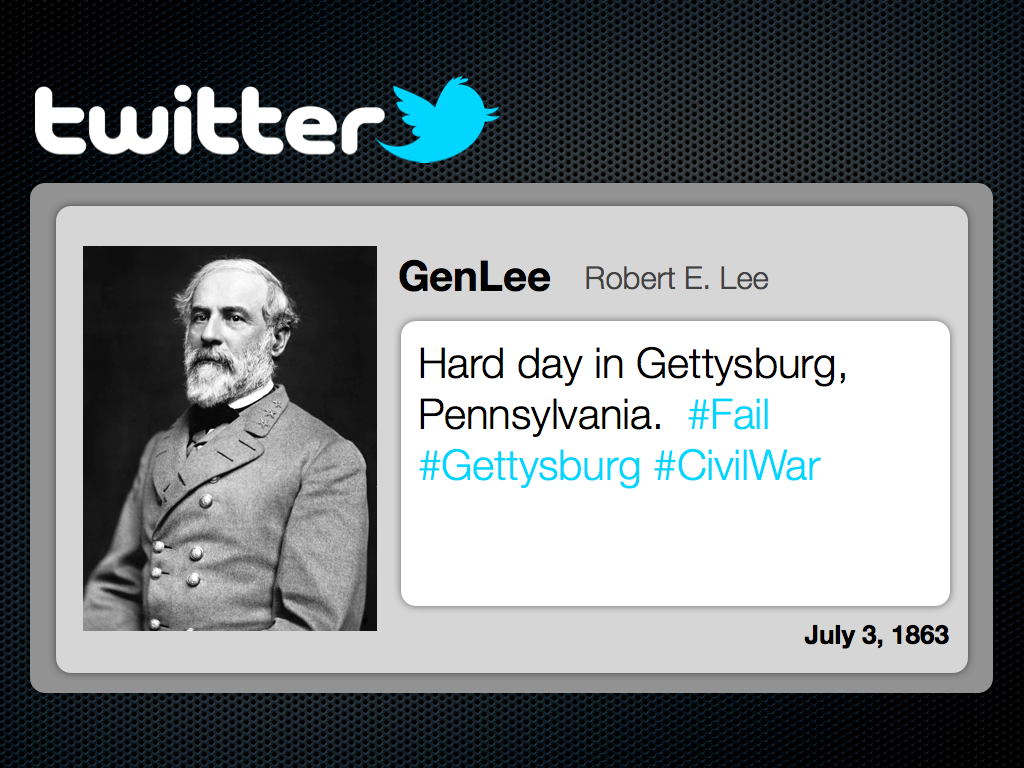
Sure George Washington and the other Founding Fathers didn’t have Facebook and Twitter, but woudn’t it have been cool if they did?  It would have been awesome to see Sacagawea’s posts about how Lewis and Clark refuse to listen and “know” where they are going.  I can imagine hew tweets [1. A message posted on Twitter consisting of 140 characters or less.] would have been re-tweeted [2. Re-tweeted messages are tweets shared in their original form by other Twitter users.] by women around the world.  The templates shared in this post are designed to let your students be creative and share the knowledge that they have gained.  These templates can be used for more than documenting the lives of historical characters.  These templates can be used for novel studies as well as creative writing.

When students use the Facebook template, they will be able to display biographical information about a historical character’s life, hobbies, career, and “friends”.  The Twitter template will challenge students to create “Tweets” that share information that is relative to the subject’s life or activities.  There is a second option inside the Twitter template, and that is the documentation of an event using a “fictional” hashtag [3. Hashtags are specific searches on Twitter using the “#” sign.  Charlie Sheen made the hashtag “#Winning” very popular during his public breakdown.]  There are example of the Facebook and Twitter templates below.  These templates were created for my MAC users, but have been exported into .ppt and .doc format.

[nggallery id=5]

Click here to download the Facebook template for MACs.

Click here to download the Twitter template for MACs.

Click here to download the Facebook template for PCs.

Click here to download the Twitter template for PCs.

« Older posts